
Design an AI-assisted support ticket triage workflow
Route and prioritise customer requests consistently while protecting sensitive cases and preserving accountable human support.
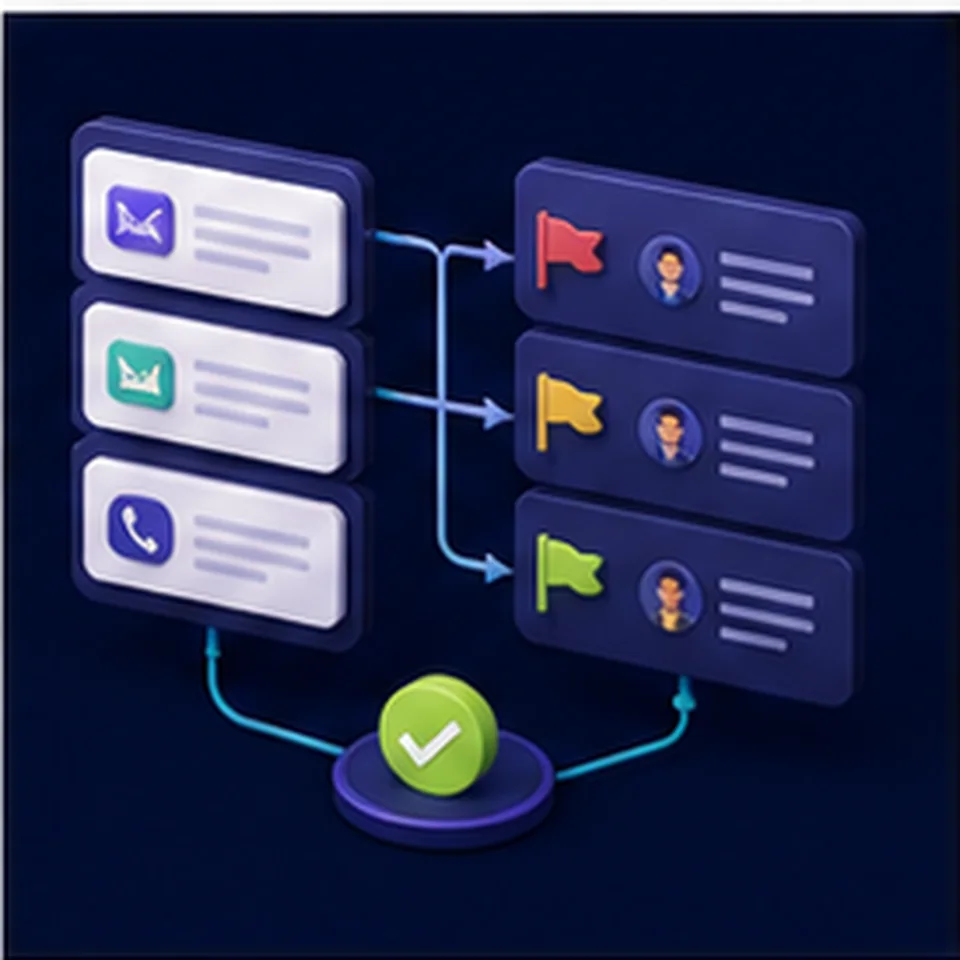
What you will produce
A reviewable result, not an automatic answer.
Follow the stages in order. Each stage ends with a tangible deliverable and a review checkpoint, so mistakes are caught before they become the next tool’s input.
Use free plans where suitable; confirm current provider limits and prices before starting. Compare the latest verified AI pricing before buying another subscription.
Suggested stack
Tools used in this workflow.
The process matters more than the brand. Use an approved equivalent when it offers the controls and output quality your organisation needs.


Inputs and ownership
Before you start
- A documented support taxonomy, service levels and escalation policy
- Representative anonymised tickets including rare and high-risk cases
- Operations, privacy and support owners available to approve the design
Interactive workflow
Complete each stage in order.
Tick a stage only after its deliverable and review checkpoint are complete.
-
Define the permitted classifications, priority rules, prohibited automation and immediate escalation conditions.
DeliverableA triage and escalation policy
Review checkpointDo not infer protected or sensitive characteristics.
-
Prepare a minimised evaluation set covering common, ambiguous, urgent, abusive and vulnerable-customer cases.
DeliverableA representative protected test set
Review checkpointSend low-confidence and consequential cases to a person.
-
Design a structured output containing category, confidence, priority, rationale and recommended human queue.
DeliverableA structured classification contract
Review checkpointKeep customer-facing replies separate from internal classification.
-
Test accuracy, false urgency, missed urgency, bias, prompt injection and failure when information is incomplete.
DeliverableA risk-weighted evaluation report
Review checkpointMeasure harmful misses as well as overall accuracy.
-
Pilot in recommendation-only mode before enabling bounded routing with monitoring and rollback.
DeliverableA monitored phased rollout plan
Review checkpointRetain a manual queue and tested rollback path.
Adapt, do not paste blindly
Working prompts for this recipe.
Replace bracketed placeholders, supply approved sources and remove unnecessary personal or confidential information.
Working prompt
Use this only after replacing every bracketed placeholder and removing unnecessary sensitive information.
Classify the anonymised support request below using only this approved taxonomy: [TAXONOMY]. Return category, priority, confidence, short rationale, missing information and the approved queue. Escalate immediately when any condition in [ESCALATION RULES] applies. Do not draft a customer reply, infer personal characteristics or invent account facts.\n\nSUPPORT REQUEST:\n[PASTE MINIMISED REQUEST]
Final review prompt
Use as a second-pass checklist, not as approval to publish.
Review the draft against this intended outcome: Route and prioritise customer requests consistently while protecting sensitive cases and preserving accountable human support. List unsupported claims, missing evidence, ambiguous language, privacy concerns, accessibility issues and actions that still require human approval. Do not rewrite the draft until the issues are listed separately.
Human review required
Verification and cautions
- Verify names, figures, quotations and source claims before use.
- Remove confidential or personal information unless the selected service and account are approved for it.
- Keep a named person responsible for the final decision and published output.
Keep the outcome, change the method
Practical alternatives
Continue with context