
Turn meeting notes into actionable tasks
Convert consented meeting notes into owners, decisions, deadlines and a concise follow-up.
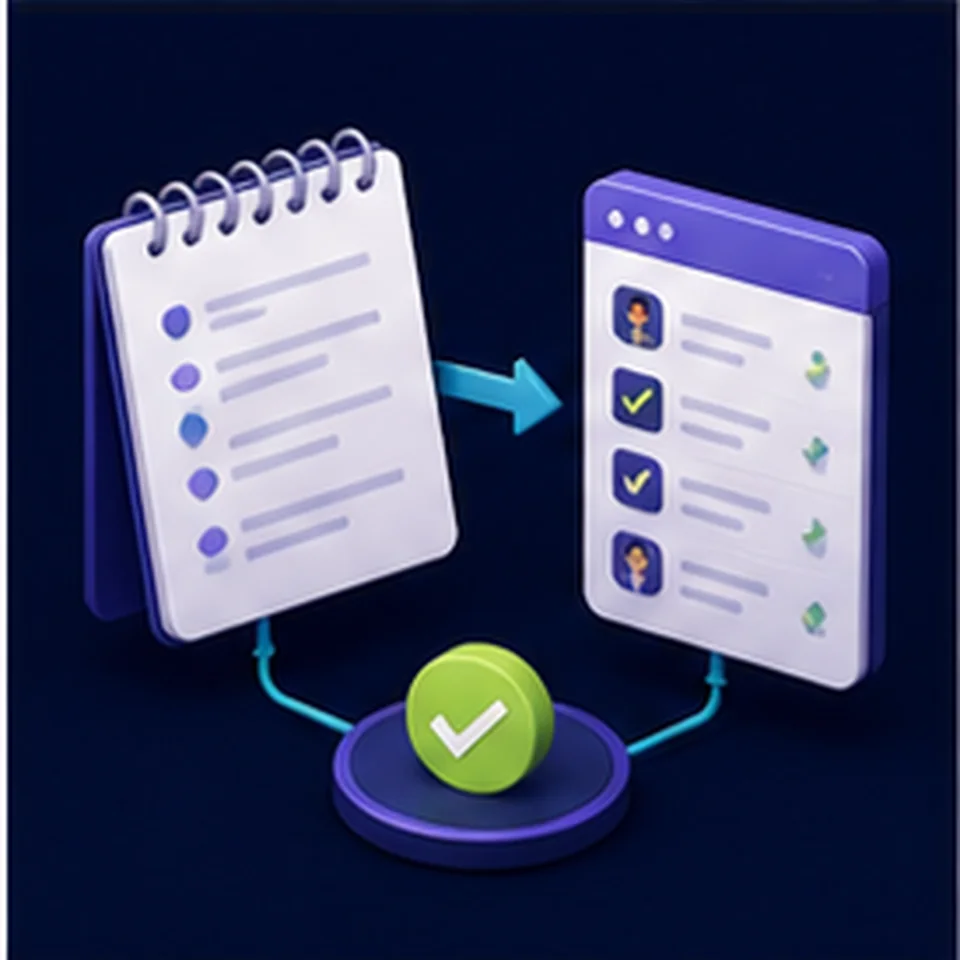
What you will produce
A reviewable result, not an automatic answer.
Follow the stages in order. Each stage ends with a tangible deliverable and a review checkpoint, so mistakes are caught before they become the next tool’s input.
Use free plans where suitable; confirm current provider limits and prices before starting. Compare the latest verified AI pricing before buying another subscription.
Suggested stack
Tools used in this workflow.
The process matters more than the brand. Use an approved equivalent when it offers the controls and output quality your organisation needs.



Inputs and ownership
Before you start
- Participant consent for recording or transcription
- A confirmed attendee and project list
- The meeting owner available to approve the summary
Interactive workflow
Complete each stage in order.
Tick a stage only after its deliverable and review checkpoint are complete.
-
Review the transcript and correct speaker names, dates and obvious transcription errors.
DeliverableA corrected source transcript
Review checkpointRetain the original recording or notes according to policy.
-
Separate confirmed decisions, open questions, risks and discussion notes.
DeliverableA structured decision and issue log
Review checkpointDistinguish a suggestion from an agreed decision.
-
Extract action items without assigning an owner or deadline that was not agreed.
DeliverableA draft action register
Review checkpointMark missing owners or dates as unresolved.
-
Ask the meeting owner to resolve ambiguous items and approve the record.
DeliverableAn approved meeting record
Review checkpointConfirm sensitive content has the correct audience.
-
Distribute a concise follow-up and place approved tasks in the team system.
DeliverableA concise follow-up with tracked tasks
Review checkpointLink each task back to the approved record.
Adapt, do not paste blindly
Working prompts for this recipe.
Replace bracketed placeholders, supply approved sources and remove unnecessary personal or confidential information.
Working prompt
Use this only after replacing every bracketed placeholder and removing unnecessary sensitive information.
Convert the meeting record below into four sections: confirmed decisions, action items, open questions and risks. Preserve the exact owner and deadline only when explicitly stated. Label anything ambiguous as “needs confirmation”. Do not infer agreement from general discussion. End with a concise follow-up email draft.\n\nMEETING RECORD:\n[PASTE APPROVED NOTES]
Final review prompt
Use as a second-pass checklist, not as approval to publish.
Review the draft against this intended outcome: Convert consented meeting notes into owners, decisions, deadlines and a concise follow-up. List unsupported claims, missing evidence, ambiguous language, privacy concerns, accessibility issues and actions that still require human approval. Do not rewrite the draft until the issues are listed separately.
Human review required
Verification and cautions
- Verify names, figures, quotations and source claims before use.
- Remove confidential or personal information unless the selected service and account are approved for it.
- Keep a named person responsible for the final decision and published output.
Keep the outcome, change the method
Practical alternatives
Continue with context