
Repurpose a recorded interview into useful content
Turn a rights-cleared interview into accurate articles, clips and social assets without losing context or inventing quotations.
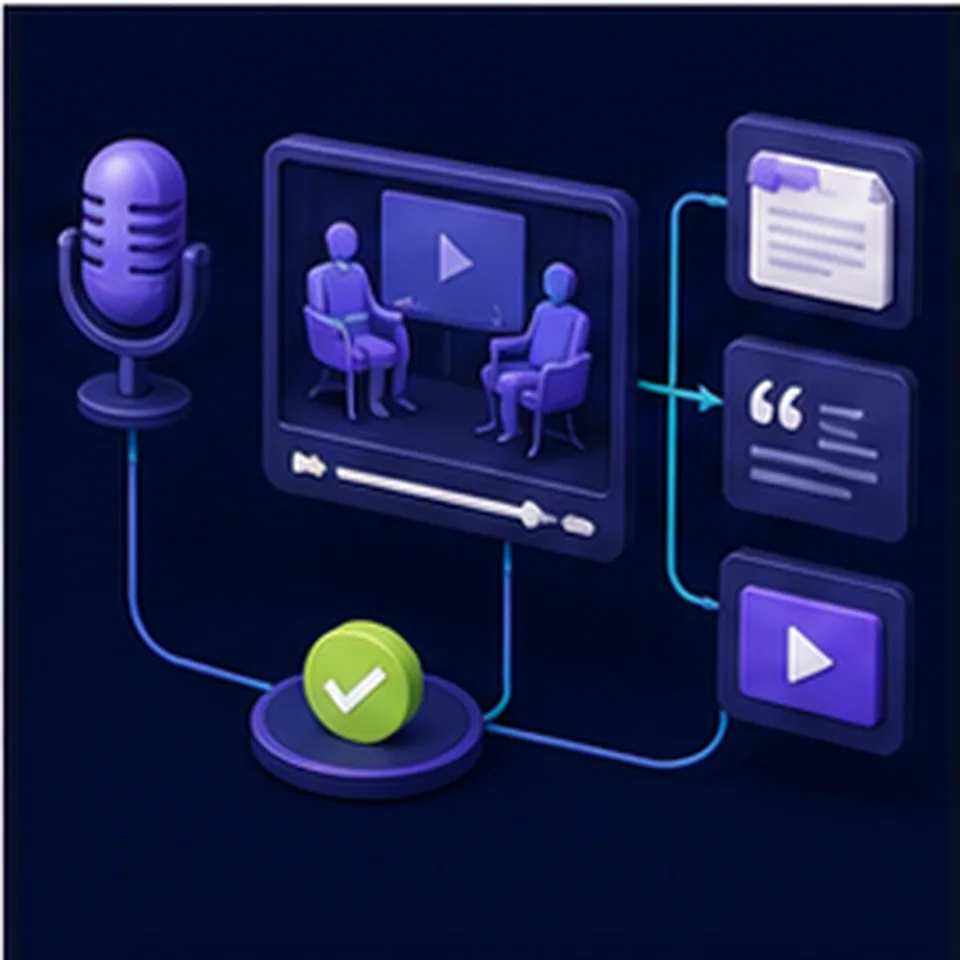
What you will produce
A reviewable result, not an automatic answer.
Follow the stages in order. Each stage ends with a tangible deliverable and a review checkpoint, so mistakes are caught before they become the next tool’s input.
Use free plans where suitable; confirm current provider limits and prices before starting. Compare the latest verified AI pricing before buying another subscription.
Suggested stack
Tools used in this workflow.
The process matters more than the brand. Use an approved equivalent when it offers the controls and output quality your organisation needs.



Inputs and ownership
Before you start
- Recorded participant consent and documented reuse rights
- A corrected transcript and approved spelling of names and organizations
- A content objective, audience and channel plan
Interactive workflow
Complete each stage in order.
Tick a stage only after its deliverable and review checkpoint are complete.
-
Correct the transcript against the recording and mark content that is private, unclear or not approved for reuse.
DeliverableA corrected rights-marked transcript
Review checkpointNever create or materially alter a quotation.
-
Identify evidence-backed themes, complete quotations and moments that remain meaningful outside the full conversation.
DeliverableAn approved theme and quotation map
Review checkpointKeep enough context to preserve the speaker’s intended meaning.
-
Create channel-specific outlines for an article, short clips, newsletter and social posts.
DeliverableA multi-format content plan
Review checkpointUse captions, transcripts and descriptive copy for accessibility.
-
Edit each asset while preserving speaker meaning, context, attribution and required disclosures.
DeliverableReviewed draft assets
Review checkpointConfirm music, imagery, voice and likeness rights.
-
Complete participant, factual, rights, accessibility and publishing review before distribution.
DeliverableA signed-off publishing package
Review checkpointLink derivative assets back to the authoritative source where appropriate.
Adapt, do not paste blindly
Working prompts for this recipe.
Replace bracketed placeholders, supply approved sources and remove unnecessary personal or confidential information.
Working prompt
Use this only after replacing every bracketed placeholder and removing unnecessary sensitive information.
Using the approved interview transcript below, identify [NUMBER] evidence-backed themes and propose an article outline, short-clip moments, newsletter summary and social-post directions for [AUDIENCE]. Quote only exact, complete wording from the transcript and include timestamps when provided. Flag unclear, sensitive or context-dependent material. Do not invent statements or speaker intent.\n\nAPPROVED TRANSCRIPT:\n[PASTE TRANSCRIPT]
Final review prompt
Use as a second-pass checklist, not as approval to publish.
Review the draft against this intended outcome: Turn a rights-cleared interview into accurate articles, clips and social assets without losing context or inventing quotations. List unsupported claims, missing evidence, ambiguous language, privacy concerns, accessibility issues and actions that still require human approval. Do not rewrite the draft until the issues are listed separately.
Human review required
Verification and cautions
- Verify names, figures, quotations and source claims before use.
- Remove confidential or personal information unless the selected service and account are approved for it.
- Keep a named person responsible for the final decision and published output.
Keep the outcome, change the method
Practical alternatives
Continue with context